Showing posts with label Bert and Dickie. Show all posts
Friday, July 4, 2014
Henley 2014: A Glorious Opening Day
Magdalen College Oxford (left) race Oxford Brooks University ‘C’ (right) in a heat of the Temple Challenge Cup (Men’s Student Eights).
Tim Koch writes:
There are three things that you do not necessarily expect on a Henley first day: some exciting racing, large crowds and above average temperatures. However, the Wednesday’s opening day provided all three. I will leave others to write more about this as I prefer to spend my time by the riverbank rather than at my computer. Also, Rachel Quarrell, writing in Wednesday’s Telegraph, does it much better than I ever could. If you are interested in weather related pictures of Henley, inter-cut with pictures of girls in bikinis, the nominally puritanical Daily Mail is for you. The full details are on the Henley Royal Regatta website (click on the event name for the stats and remember that some of the top events do not start until later in the week).
Members of the Amsterdam Student Rowing Club Nereus model blazers of varying ages and conditions.
Members of Oxford Brooks University ‘B’ find that losing is not as good as winning. They were beaten by University of Michigan, USA, in a heat of the Temple Challenge Cup (Men’s Student Eights).
My day was spent in the delightful company of some very special guests, all linked by a common theme. I had invited John Beresford (son of Jack Beresford, Britain’s most successful oarsman in the pre-Redgrave era) and Sue and Molly Bushnell (daughter and grand-daughter of the indomitable Bert Bushnell) as my guests. When we met up later in the day with Tizzy Burnell, daughter of the former ‘Grand Old Man’ of British rowing, Richard ‘Dickie’ Burnell, we had a gathering of the ‘Children of 1948’. ‘Bert and Dickie’, coached by Jack, were, of course, the unlikely pairing who won the double sculls at the 1948 London Olympics, an event recently dramatised in a BBC television programme. As regular readers will remember, this production was extensively covered by ‘Hear The Boat Sing’. This meeting was made even more special through the generosity of the Chairman of Henley Royal Regatta, Mike Sweeney, who arranged for us to follow two races in the umpires’ launches and allowed us access to the hallowed Committee Lawn, an area for the Stewards and their guests. It was a gesture very much in the traditions of Henley and was much appreciated by all concerned. Here are some pictures of a memorable day.
Members of Rowing Royal Families pictured, appropriately, in front of the Royal Rowbarge, Gloriana. The press picked up on the story and they were interviewed and photographed by the Henley Standard newspaper (read article here). From left to right, John Beresford, Tizzy Burnell, Sue Bushnell and Molly Bushnell.
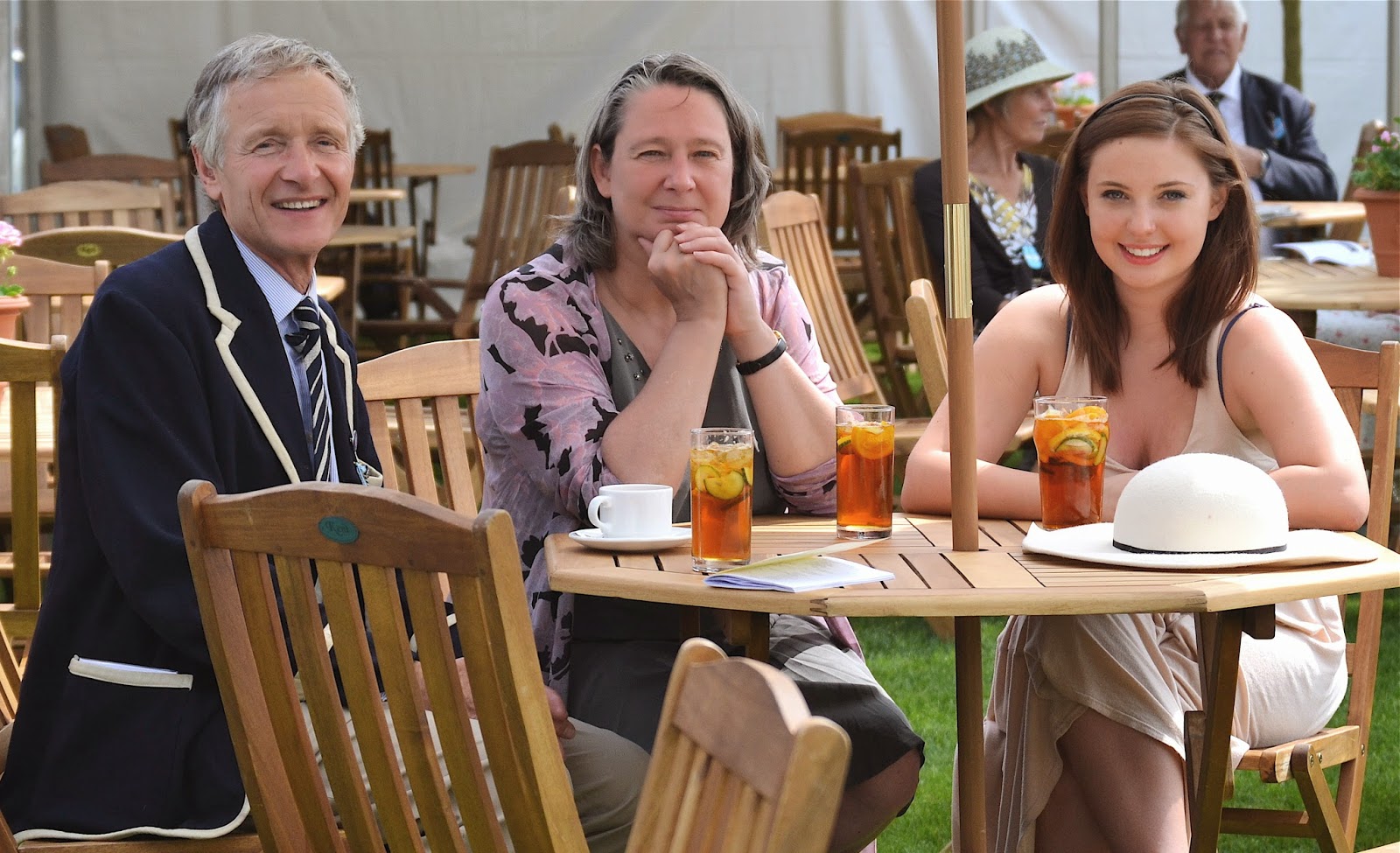
Pimm’s on the Committee Lawn. It does not get more civilised than this, John, Sue and Molly.
Tizzy Burnell introduced us to the ‘Bengal Tiger’, a non-alcoholic cocktail invented by her Grandfather, Charles ‘Don’ Burnell, who won in the eight at the 1908 Olympics (Don and Dickie are the only father and son in Olympic history to have won gold medals in rowing). When Don was umpiring at Henley he felt that he could not drink wines or spirits at lunchtime (something that, in the past, some of his colleagues were not so strict about) and so produced this drink which feels as if it has alcohol in it. It is a mixture of ginger beer, lime juice and Angostura Bitters. If you are not umpiring, you can add vodka.
Sue and Molly followed the race between Cambois and Nottingham in a heat of the Wyfold Challenge Cup (Club Coxless Fours).
John and I followed the race between the University of the West of England (UWE) and Goldie Boat Club in a heat of the Prince Albert Challenge Cup (Men’s Student Coxed Fours). It was a convincing and no doubt enormously satisfying win by the unfashionable UWE over the crew from the more prestigious Cambridge University Boat Club.
The UWE – Goldie race from umpire John Hedger’s point of view.
Tim Koch writes:
There are three things that you do not necessarily expect on a Henley first day: some exciting racing, large crowds and above average temperatures. However, the Wednesday’s opening day provided all three. I will leave others to write more about this as I prefer to spend my time by the riverbank rather than at my computer. Also, Rachel Quarrell, writing in Wednesday’s Telegraph, does it much better than I ever could. If you are interested in weather related pictures of Henley, inter-cut with pictures of girls in bikinis, the nominally puritanical Daily Mail is for you. The full details are on the Henley Royal Regatta website (click on the event name for the stats and remember that some of the top events do not start until later in the week).
Members of the Amsterdam Student Rowing Club Nereus model blazers of varying ages and conditions.
Members of Oxford Brooks University ‘B’ find that losing is not as good as winning. They were beaten by University of Michigan, USA, in a heat of the Temple Challenge Cup (Men’s Student Eights).
My day was spent in the delightful company of some very special guests, all linked by a common theme. I had invited John Beresford (son of Jack Beresford, Britain’s most successful oarsman in the pre-Redgrave era) and Sue and Molly Bushnell (daughter and grand-daughter of the indomitable Bert Bushnell) as my guests. When we met up later in the day with Tizzy Burnell, daughter of the former ‘Grand Old Man’ of British rowing, Richard ‘Dickie’ Burnell, we had a gathering of the ‘Children of 1948’. ‘Bert and Dickie’, coached by Jack, were, of course, the unlikely pairing who won the double sculls at the 1948 London Olympics, an event recently dramatised in a BBC television programme. As regular readers will remember, this production was extensively covered by ‘Hear The Boat Sing’. This meeting was made even more special through the generosity of the Chairman of Henley Royal Regatta, Mike Sweeney, who arranged for us to follow two races in the umpires’ launches and allowed us access to the hallowed Committee Lawn, an area for the Stewards and their guests. It was a gesture very much in the traditions of Henley and was much appreciated by all concerned. Here are some pictures of a memorable day.
Members of Rowing Royal Families pictured, appropriately, in front of the Royal Rowbarge, Gloriana. The press picked up on the story and they were interviewed and photographed by the Henley Standard newspaper (read article here). From left to right, John Beresford, Tizzy Burnell, Sue Bushnell and Molly Bushnell.
Pimm’s on the Committee Lawn. It does not get more civilised than this, John, Sue and Molly.
Tizzy Burnell introduced us to the ‘Bengal Tiger’, a non-alcoholic cocktail invented by her Grandfather, Charles ‘Don’ Burnell, who won in the eight at the 1908 Olympics (Don and Dickie are the only father and son in Olympic history to have won gold medals in rowing). When Don was umpiring at Henley he felt that he could not drink wines or spirits at lunchtime (something that, in the past, some of his colleagues were not so strict about) and so produced this drink which feels as if it has alcohol in it. It is a mixture of ginger beer, lime juice and Angostura Bitters. If you are not umpiring, you can add vodka.
Sue and Molly followed the race between Cambois and Nottingham in a heat of the Wyfold Challenge Cup (Club Coxless Fours).
John and I followed the race between the University of the West of England (UWE) and Goldie Boat Club in a heat of the Prince Albert Challenge Cup (Men’s Student Coxed Fours). It was a convincing and no doubt enormously satisfying win by the unfashionable UWE over the crew from the more prestigious Cambridge University Boat Club.
The UWE – Goldie race from umpire John Hedger’s point of view.
Tuesday, May 6, 2014
Interview with Ron Irwin, Author of Flat Water Tuesday
Ron Irwin
After yesterday's review, HTBS caught up with Ron Irwin, author of the well-received novel Flat Water Tuesday, which was published in June last year. Today, on 6 May, the book will come out in paperback in the U.S., so HTBS decided to ask Ron some questions:
HTBS: First, congratulations, Ron, on a marvellous first novel.
Thank you very much! It is a real pleasure to do this interview for your excellent website.
HTBS: You went to Kent School in Connecticut, known for its rowing programme, and you rowed there, after having started your rowing career in high school in Buffalo, New York. After Kent, you went on to Trinity College (Hartford, Connecticut), where you also rowed. Is your novel’s fictional Fenton School, also in Connecticut, based on Kent School? Would some of your old school mates/rowers or teachers/coaches recognise themselves and some events that took place during your time at Kent and/or Trinity?
The novel is very much based upon my experience at Kent. In fact, my literary agent was also my roommate and a fellow rower! The film rights to the novel are held by another rower from Kent named Lars Winther. When the novel was first released in hardcover format in June of 2013, I did a book signing at the school. I happened to be back because it marked my twenty-fifth reunion. It was a wonderful time for me and a means of reconnecting with people I had not seen in a very long time. Much of the dramatic material in the novel, however, came from my experience as a rower at Trinity College. All in all, I rowed for about eight years of my life and it was an extremely rewarding experience.
HTBS: Any particular parts of the novel that you have experienced yourself in real life? Friends committing suicide? Struggling love affairs? Fighting at hotels? etc.
I always answer that question by saying that 90% of what happened in Flat Water Tuesday actually did happen, and the other 10% could have happened! As a writer, I found myself rearranging and dramatizing many of the real-life episodes that I describe in the novel. There are, of course, a few stand out elements that hang over the dramatic structure of Flat Water Tuesday. Firstly, a rowing friend of mine did indeed commit suicide, but he did not go to boarding school with me; he was a rower on the Trinity team. I actually did not know him very well, but he seemed to be one of those kids who had it all: he was good-looking, he was popular, and he was an excellent athlete. His death hit us all. I got the call about a year or two after I graduated that he had quite unexpectedly killed himself and he had not left a note or spoken to anyone about any issues that were plaguing him. A lot of the guys I used to row with got in touch with each other just to say we were there for one another and to remind ourselves that we were part of a larger, supportive community.
The love affair between Carolyn and Rob is also very real to me, as is the loft where it all happens. Their loft in New York is a very real place, I remember visiting it years ago when two of my friends stayed there and thinking it would make a wonderful setting for a novel. The guy who stayed there, Enrico Brosio, was another rower from Trinity who was a very good friend of mine and who now lives in London. He and I not only rowed together, we skied all around the world together.
Carolyn is also a very real person. There are women in this world who make a profound impression on the people they meet and she is one of them. Rob and Carolyn’s story is sadly very universal: how do two people love each other hold on after one of them makes a tragic mistake? How do you put down the defenses and say to somebody that they are the one? Rowing is all about toughness and discipline and pushing through pain. This is sometimes not the best approach to a romantic relationship where at times one must be vulnerable and, more importantly, protect another person’s vulnerability. Carolyn is certainly a person who exists in real life. She is a difficult person, but a passionate person and a beautiful person and someone whom the main character is deeply in love with. Flat Water Tuesday is partly about just how far you go to hold onto that love, even when you know it might end tragically.
HTBS: When you had made up your mind to write your début novel were you clear from the start that rowing would be an important element in the book?
Oh yes, certainly. In fact, the first draft of the novel was just about rowing. It did not have the adult love story at all. Even when I was rowing in high school I knew I would write about it one day. Rowing is just an incredibly dramatic sport, and it is an incredibly beautiful sport. The tensions and the excitement around putting together a top boat seem, at least to me, perfect for novel. I’ve always been passionate about rowing, ever since I first stepped into a shell. Twenty years ago, I was amazed that there were so few books about the sport. It is just so exciting, and so very poetic. Unfortunately, the first draft of my novel was turned down because the dramatic structure really wasn't going to work over three hundred pages. I also had to live a little bit more outside of the boat before I could write the novel that is now in the bookstores.
I realized one day that what I really wanted to look at was how all this rowing affected the characters later in life. Did they grow up to be better people? Did it really help them succeed? I found that rowing certainly helped me handle difficult times in my life and to focus on long-term projects that were sometimes fraught with failure, but on the other hand rowing teaches you to be incredibly distant in regard to the suffering of other people. Rob Carey is a character who finds empathizing with others to be extremely difficult, partly because he pushes himself so hard. This has tragic consequences for him.
HTBS: You are also a documentary filmmaker just like the grown-up Rob Carrey, the main character in your book. As a fiction debutante, did you feel more safe to write about two subjects that you knew well, rowing and filmmaking?
I am not sure if it was a matter of “feeling safe” so much as feeling as if these experiences had wonderful potential for a novel. I enjoyed my experience making documentary films and it was certainly an exciting life. It seemed as if those experiences would work well in the context of a longer narrative. The interesting thing about making documentary films is that you suddenly are exposed to all of these other stories. You get intimately involved in other people’s lives.
But on the other hand it is a business after all and there are certain technical things you have to learn. I found that the people I met in the documentary film world were incredibly hard-nosed and yet at the same time incredibly optimistic about life and the human condition. Making documentary films is also an immensely physical job. You are traveling around the world and carrying lots of equipment to pretty inaccessible places. So I always thought while I was doing it that I would only be able to handle it for so long and then I would put it into the pages of the novel. Mission accomplished!
HTBS: Did you do a lot of research for the rowing parts of the novel? Did you ever run into problems writing about the technical parts in rowing? The coaching? The land and the winter training? Or did you write these parts from memory from rowing at Kent and Trinity?
I would say that about 80% of the novel was written directly from memory. But the real problem was educating a reader who knows nothing about rowing about the intricacies of the sport. I had to slowly define the basic parts of the boat, where people sat, what the stroke was, the various complexities of competition, and the importance of training while at the same time moving the narrative forward. I showed the book to many people who had no experience of rowing at all to make sure they understood what was going on. This is not an uncommon problem for novelists. Anyone who has written a techno-thriller – where the lay reader has to understand how a submarine works for example – understands this problem. I kept thinking back to the seafaring novels of Patrick O’Brian. He introduces lots of seafaring terminology into his work that the reader has to quickly absorb. So, I kind of thought of the members of The God Four as people out at sea. I made sure to simply drop in the various terminology that every single rower knows about, and make it part of the action so people would organically understand what was going on. Rowing is complex, but it is not as complex as writing about what it must be like to be an astronaut or a brain surgeon or a spy.
HTBS: As other coming-of-age novels, your book has been compared to John Knowles’s A Separate Peace, and personally, I found some resemblance between the novels. If you agree, was it a deliberate choice you made or did it just happen?
Many people have compared the novel to A Separate Peace, but the reality is that I never have read that novel! I remember reading Catcher in the Rye and enjoying the first-person narration immensely. The challenge that lies in writing about a teenage hero is that teenagers are so incredibly self-absorbed. They really do not have the best sense of irony. There's not a lot of self-deprecation going on at that age. And, moreover, I was reaching back into that time what I wrote Flat Water Tuesday. I decided to have two different voices. The adult voice, which is essentially my voice, and the teenage voice. The teenage voice is a voice I have lost touch with. It was good to get to know that person again, but I doubt I will have anything to do with him for the rest of my life.
HTBS: If I understand it right, it took you a long time to write Flat Water Tuesday. Was it because you got rejected by different publishers, or was it because you were not pleased with the result/s? Did you have to do a lot of re-writing before you felt the manuscript was ready to be sent off to your literary agent?
I wrote the first draft of Flat Water Tuesday back in 1995. The book was picked up by a literary agent and shown to about two dozen New York publishers. The problem with the novel was that it was simply about a young man trying to make a very competitive rowing team. There was no suicide, there was no romance, there was no adult story. So editors back then wondered how they could sell a story there was essentially about teenagers to adults. I had a wonderful agent who was very supportive and thought that the novel was indeed universal. Many novels had come out about teenagers at prep school that garnered an adult audience but mine was not so much about “coming-of-age” so much as about survival. So the kind of feel-good aspect was not there: it really was a technical story about making a rowing team as an eighteen-year-old. I rewrote the novel and resubmitted it in 1997, but still the adult section was not there. It was again rejected by about two dozen publishers, including, amusingly, St. Martin’s Press, who ultimately took on the manuscript. I gave the story a rest and took the time to get married and build a house and have children and do a great deal of nonfiction writing.
But Flat Water Tuesday was always with me, and I decided after the death of a very respected colleague here at the University of Cape Town, where I work, that I would get it published. I opened up the now very old manuscript in 2010 and began the process of rewriting it because what I had was incredibly dated and, truth be told, a bit immature. I wound up rewriting about 90% of the original manuscript. I also added in the love story. Basically, I had experienced a great deal in my life since I put Flat Water Tuesday aside. I poured those experiences into the novel.
And then, fate seemed to lend a hand. My former rowing coach, Hart Perry – a legend in the world of rowing – died in 2011. My former teammates called me from Connecticut, where a memorial had been held for him. They had heard that I was writing a novel about our experiences on the water and urged me to finish the manuscript I had already begun working on. This seemed like some kind of cosmic command. I redoubled my efforts and got back into contact with Tris Coburn, a fine rower and my former roommate. He was now working as a literary agent and he assured me that if I were to finish the manuscript he would show it around New York. My original agent had retired by this time. So I redoubled my efforts. Then, out of the blue, I was contacted by one of the fiction editors from St. Martin’s Press. She was visiting Cape Town, where I live, and wanted to have lunch with me. By the time that lunch was over, I had told her about the novel and she asked me to send it to her via e-mail. The rest is, as they say, history.
HTBS: Is there a specific ‘scene’ that you are especially fond of in your novel? Any person you feel close to? If so, why? Is there a ‘scene’ that you feel sorry that you cut out that is not in the novel?
To me, the heart of the novel is what I call the “crooked room” scene. This is the scene where Carolyn brings Rob up to her loft in New York and tells him that she calls it the “crooked room”. That is a scene I wrote many times and to me it encapsulates the passion of the novel. I've said it many times: Flat Water Tuesday is not really a rowing novel. It is a love story. The novel was written for Carolyn.
HTBS: Yes, your novel is a love story, but maybe not only between the grown-up Rob and Carolyn, but is there not also a latent love, or at least a fling, between the young Rob and The God Four coxswain, Ruth. Would you also say that the young rowers in your novel have “a love affair” with rowing?
I think that is very accurate. At that age, you are so desperate to be part of a group. Rowing offers a kind of instant elitism. There is no question that the closeness that I felt on the water with many of my teammates was impossible to replicate later in life. I am now taking up the sport again and while I enjoy it, I could not imagine spending so much time with the men I row with. But, as we all know, rowing is a sport that is easy to fall in love with. I am glad I went through that very intense experience when I was a kid and when I was in college. Rowing has made me many friends whom I am still in touch with.
The biggest discovery I have made about rowing is how serious people are about it as adults! I row with guys in their sixties who are very committed to the sport and can really make a boat go. I just had lunch with a yoga instructor who told me that many men in their fifties are only fractionally weaker than what they were as teenagers. I would agree. I am amazed how hard I am rowing now, and how much more I enjoy just being out on the water than I did back then, when I was always obsessed with winning. That said, I would hate for anyone to read the novel and think I was saying anything negative about the sport or indeed about Kent. Yes, tragic things happen to the main characters, but the main characters are very intense people and I put them in an incredibly intense situation. I remember well just how much I wanted to win certain races, and the novel takes this to a logical but catastrophic conclusion. Nonetheless, I am a major supporter of the sport of rowing and indeed The Kent School. I would definitely do it all over again, and start even earlier as an oarsman.
HTBS: The large chain store Target in the USA has picked Flat Water Tuesday paperback as a Book Club Pick for the month of May. Target has ordered 30,000 copies. Of those books you have signed 5,000 – how long did it take you to sign them all, and how did your hand feel afterwards? How many copies of the paperback are being printed in the first run?
It took me a week to sign all of the Target copies! My former mentor at UCT, Prof. J.M. Coetzee, who is no stranger to book signings as he has won the Nobel Prize, wrote from Australia to tell me I was lucky I had such a short name. It would have been even rougher if I was named Cherry Chevapravatdumrong, for example! Copies of the paperback are now in bookstores as well as in Target. I am not sure what the total print run is, I assume it is pretty substantial.
Ron Irwin busy signing 5,000 copies of the paperback edition of Flat Water Tuesday for Target.
HTBS: When you were writing the novel, did you ever imagine that it would be this successful?
I always tell my students that being a “successful” writer means, really, getting good reviews and the respect of your peers while at the same time not actually losing money for your publisher. It is very difficult to predict what will be a bestselling novel. Flat Water Tuesday has had its share of success, but I am just pleased that the novel has been received so well and that so many people have taken the time to write me emails saying that I have captured what it is like to row in a very fast boat. Even more important, I enjoy getting notes from people who have been through the kind of loss that Carolyn and Rob face.
HTBS: Rather early on, when your hardcover edition had come out, a film company bought the rights to make a movie based on your book. Please tell us more about it. Have you seen a script? Any idea which actors are going to play the members of The God Four or Coach Channing, for example?
I have indeed seen the script. It was written by Todd Komarnicki, the person who, among other things, produced the movie Elf starring Will Farrell. He has of course done a great deal of other adaptation work. He and I spent the weekend together at Kent shortly after the publication of Flat Water Tuesday. He met many of the people who I used to row with, and took the time to actually learn how to row before he began work. The film rights are held by Lars and Peter Winther, and Lars knows the sport extremely well, having rowed on the team that is the inspiration for The God Four. We have some ideas about who should act in the film but it is still early days yet. I can say that the script is excellent.
HTBS: do you see a trend in that three of the most written and talked about rowing books during the last years - I am here thinking about Dan Boyne’s Kelly: A Father, a Son, an American Quest (2008; pb 2011), Daniel James Brown’ s The Boys in the Boat (2013; pb 2014) and your Flat Water Tuesday (2013; pb 2014) – all have had film companies buying the rights to make movies based of these books? Is rowing on its way to become a new favorite Hollywood sport?
I think that rowing is certainly going to find its place in Hollywood. There have been some pretty good movies in the past. Think about the popularity of Oxford Blues, for instance, which stars Rob Lowe. There is also an old Nick Cage movie called The Boy in Blue and a recent BBC film called Bert and Dickie about two men in the 1948 Olympics, which is based on a true story. Two years ago the movie Backwards came out, about a girls’ rowing team.
But you may find it amusing to learn that my editor at St. Martin’s told me that their interest in the novel came partly from the movie The Social Network! This film features two very famous Harvard rowers – Tyler and Cameron Winklevoss – who become the enemies of Mark Zuckerberg. Apparently the rowing sequences in The Social Network led to a great deal of interest in the sport on the part of the folks at St. Martin’s and in turn in my novel. Maybe in a weird way I owe Mark Zuckerberg something for getting on the bad side of such fearsome rowers!
Until recent years, rowing has always been very difficult to film. It is hard to film a boat from another boat and still keep a level camera. Recent Steadicam technology as well as other digital advances have meant that you can get right into the boat with the rowers without sacrificing film quality. Right now, for instance, you can go to YouTube and see some really cool GoPro footage of rowing put together by total amateurs. It used to be really hard to get that kind of footage. The trick is, in my opinion, to show how difficult the sport is while at the same time showing how beautiful it is. I remember when I was in high school in Buffalo how the kids who played hockey felt rowing was a “sissy sport” because, to them, it looked so easy. I would imagine that it's sort of like filming ballet. Ballet looks beautiful and graceful, but the body of every single ballet dancer I know has taken a severe physical beating because dance is just so rigorous. When you film ballet or rowing, you want to show the blood and sweat as well as the beauty. The technology is now there to make this happen.
HTBS: Which is your favorite rowing movie/film?
I would have to say that my favorite film is the 1970s documentary Symphony of Motion, probably because I know some of the people who were filmed in it and there are simply so many classic faces it. I also really enjoyed the film True Blue about the Oxford Boat Race “mutiny”, based on the book by Dan Topolski. I think this is an excellent introduction to the sport and looks at some of the nuances that would be very difficult to explain to outsiders.
HTBS: Which is your favorite rowing book?
The best book ever written about the sport of rowing is easily David Halberstam’s The Amateurs. This is a nonfiction book about four young men trying to make the 1984 Olympics. I am sure that most of your readers know about it.
HTBS: Which novels have had the most impact on you as a writer? Is there a particular book that made you want to write?
I think that the work of Cormac McCarthy, as well as the work of Richard Ford and Michael Cunningham has had a major effect on me. I also greatly enjoyed the novels by my mentor at UCT J.M. Coetzee. Studying under Prof. Coetzee was on incredible experience not least because here was a person who not only was a kind of living legend, but also who literally risked his life as a novelist. He wrote novels like The Life and Times of Michael K and Waiting for the Barbarians during a time when he could have been thrown in jail for the things he implied about the apartheid government. I like to think I am a committed writer. But I am not sure I would risk jail time under the old South African regime for my art. I would certainly not be willing to risk the lives of my family members to publish a novel. Prof. Coetzee did that. He taught me that writing was a serious business. Literally a matter of life and death.
HTBS: You must be thrilled to learn that Flat Water Tuesday has been put on the long list for the Sunday Times Fiction Prize in South Africa just the other day. What does this mean for the novel?
It is indeed great news. The Sunday Times Fiction Prize is the most important literary prize in South Africa. Flat Water Tuesday is published here by Pan Macmillan SA and they have been tireless in their support of it. I have met many people who have happened to read the book, and it seems to be doing the rounds at the local private schools where rowing is popular. The short list gets announced at a party during the Franschhoek Literary Festival on 17 May, and a few weeks after that they will announce the winner. Some major names in South African fiction have won the prize: Andre Brink, Zakes Mda, Justin Cartwright among them. Some of the other winners are personal friends and colleagues. I have no idea if I will make the short list, but I am certainly looking forward to going to the Franschhoek Literary Festival, FLF, and having a drink with the other ‘longlisters’ and cheering on whoever gets tapped. The FLF is hugely popular down here and is really the landmark literary event on the South African calendar. Franschhoek is a beautiful town: imagine Edgartown in Martha's Vineyard transplanted into a beautiful wine region and you get the idea. Wine and books are a fine and time honored pairing, in my opinion.
HTBS: We will certainly keep our fingers crossed that Flat Water Tuesday is picked for the short list.
Thanks, Göran.
HTBS: With the great success of Flat Water Tuesday, are you now working on your second novel? And if so, what will it be about?
I think the next novel will take place in Cape Town. I have come across a female character who doesn’t seem to want to go away, so I think I will follow her and see where she takes me.
HTBS: Thank you, Ron, and good luck with Flat Water Tuesday and with your second novel.
Thank you.
You can find out more about the novel Flat Water Tuesday by visiting www.flatwatertuesday.com. Please feel free to “like” its Facebook page at www.facebook.com/fwtnovel
Flat Water Tuesday can be bought at your local book shop, Target and the online bookstores.
Friday, May 2, 2014
F. Collar ~ Oarmaker
On the cover of the May 2012 issue of Rowing & Regatta, British Rowing's publication, 'Bert' and 'Dickie' were holding sculls made by the oarmaker Collars for the film about the two Olympian champions Bert Bushnell and Dickie Burnell.
Yesterday, Greg Denieffe made a nice find on YouTube, a film about the oar and scull making business F. Collar in Oxfordshire. Frank Collar, whose father and grandfather had been oarmakers, decided in 1932 to leave his accounting work to start building oars and sculls in Oxford, and soon his father joined him. The company still exists today, now also making masts for yachts. Below is the fine film about two museum volunteers who set out to find more information about Frank Collar and Ron Cousins, who joined Collar in the oarmaking business. Enjoy!
Thursday, May 1, 2014
Repechage for Bert and Dickie
1948: The real Richard Burnell (stroke) and Bert Bushnell (bow).
Tim Koch writes:
British readers with access to the Drama Channel (Freeview 20, Sky 166, Virgin Media 190) will be able to see a repeat broadcast of Bert and Dickie at 9pm on Saturday, 3 May. Called Going for Gold in the U.S., this is a dramatised account of the unlikely pairing of Bertram ‘Bert’ Bushnell and Richard ‘Dickie’ Burnell who won the double sculls at the 1948 London Olympics. The HTBS review is here and newsreel film of the real thing is on the British Pathe site.
Matt Smith plays Bert Bushnell and Sam Hoare plays Dickie Burnell.
Tim Koch writes:
British readers with access to the Drama Channel (Freeview 20, Sky 166, Virgin Media 190) will be able to see a repeat broadcast of Bert and Dickie at 9pm on Saturday, 3 May. Called Going for Gold in the U.S., this is a dramatised account of the unlikely pairing of Bertram ‘Bert’ Bushnell and Richard ‘Dickie’ Burnell who won the double sculls at the 1948 London Olympics. The HTBS review is here and newsreel film of the real thing is on the British Pathe site.
Matt Smith plays Bert Bushnell and Sam Hoare plays Dickie Burnell.
Friday, August 10, 2012
‘Bert And Dickie’: Drama Or Farce?
Let's continue with the 1948 Olympic rowing from a little different angle. Here HTBS's Tim Koch writes about the BBC film Bert and Dickie (called Going for Gold in America):
It is normally advisable to take a ‘Dr Johnson’ approach to any drama centred on rowing. The 18th-century man of letters famously said:
‘Sir, a woman’s preaching is like a dog’s dancing on his hind legs. It is not done well; but you are surprised to find it done at all.’
Films about rowing are rare and are rarely done well. Film makers prefer to make dramas about popular land based sports as the action sequences are considerably easier to shoot and edit to produce a reasonably convincing scene where an actor is portraying a top class athlete. As far as I know the only rowing sequence in a movie that convinces those who know about the sport is the Henley scene in The Social Network. When ‘rowing dramas’ are made they tend to closely follow the clichés set out in the guide ‘How to Make a Rowing Movie’ on the now sadly inactive ‘Tideway Slug’.
Geoffrey Palmer is playing Dickie's father, the 1908 Olympic rowing champion 'Don' Burnell.
Bert and Dickie, however, threatened to be different. Firstly, it was made by the BBC who, famously, are rather good at this sort of period drama. Secondly, it had what film and TV people call ‘high production values’ that is, they spent time and money attempting to get it right. Thirdly, it employed some very talented actors in both lead and supporting roles. This included the wonderful Geoffrey Palmer who, as far as I know, had never appeared in anything bad – despite always playing much the same character. Finally, a large part of Britain and the world are in an ‘Olympic Mood’. At the present time many of us are susceptible to a ‘feel good story’ of plucky chaps winning against the odds. I wanted to like this programme.
The basic ingredients of a dramatic story are all there. An ‘odd couple’ are thrown together by circumstances not of their making. They do not like each other. There is social snobbery and economic deprivation. Eventually they learn to ‘pull together’ because they realise that they have a common goal and because they discover that they have a common problem. In this case, the problem is slightly mad fathers, Dickie’s dad representing the old order where it’s the taking part that counts, Bert’s dad representing the future, believing that winning is all. The tension on the Henley Reach is punctuated by gentle humour on land. There are several delightful cut aways to conversations between the Prime Minister and Chairman of the British Olympic Committee as they wrestle both with the great concepts and the mundane detail of the Games. There are funny and touching scenes where post war ‘austerity’ Britain attempts to make the best of things, especially in the presence of the over cossetted Americans. Unfortunately, the cutaway scenes where Bert’s banished girlfriend (a slightly superfluous role) watches the races from a TV shop in Scotland with a local policeman relaying the commentary to the crowds outside (and to the viewer of course) is an unsatisfactory device. Possibly it is some sort of homage to the British ‘Ealing’ comedies of the 1950s.
Of course, the eternal problem of a story ‘based on real events’ is that we all know how it ends. Thus we have to enjoy the journey that takes us to the predictable and inevitable conclusion – in this case Olympic glory and approval from respective fathers.
A review of this journey on Hear The Boat Sing must be slightly different to one in most other places. ‘Dramatic criticism’ is one part but for rowing historians there is also the question of the accuracy of people, events and objects.
How does Bert and Dickie work as a piece of entertainment? It is commonly observed that ‘drama’ is real life with the boring bits taken out. In this necessary process the characters can become slightly one-dimensional, emotions can, unnaturally, change in an instant and all difficulties are unrealistically permanently overcome. ‘B and D’ is not immune from these faults – but very few dramatic productions are. For me, these criticisms did not spoil my enjoyment of ‘the journey’ from start to finish. The combination of an intelligent script, good acting, high production values and wonderful cinematography (with light use of CGI) makes a very simple story work. It is, simply, a bit of fun. For Brits, still basking in post-Olympic Regatta success with their cynicism blunted, the pleasure is highlighted.
Was it ‘accurate’? In a couple of words – pretty much. Yes, the sculling was bad, we knew it was going to be, let’s accept it and move on. The boats and equipment seemed correct. The costumes were fine bar the inaccuracy, pointed out by Jack Beresford’s daughter, that her ‘father’ was portrayed wearing a brown suit at the Olympic Regatta! The stand in for the Leander clubhouse was a little over grand and the unimpressive Leander pontoon was replaced by the more substantial Eton Rafts but there is nothing ‘wrong’ with such things. The only inaccuracy that made me wince was when Don Burnell said that he won an Olympic gold medal in 1908 in ‘the men’s eights’. I am sure that Burnell senior would have never made such a 21st century gender distinction, it was like having the character say something like ‘you is well good’. On the other hand, I did actually learn something. The film portrayed Jack Beresford Jnr. as, in Chris Dodd’s words, ‘mentor rather than coach’. I would have dismissed this as one of the things film makers do to keep the story flowing had Chris not agreed that this was in fact the case.
I must further commend writer William Ivory (on the right) and director David Blair because, not only was their production reasonably accurate, but it was also brave in that it did not avoid introducing slightly difficult ideas for a non-rowing audience. In the best traditions of the BBC, there was little ‘dumbing down’. There were references to rowing’s contracted amateur – professional debate, detail on rigging and rowing technique, and a discussion on using the repêchage system to gain an advantage. These ideas could have easily been passed over to keep the interest of the least attentive viewer, something all too common in modern film and television.
The ‘clincher’ for me (and anyone associated with this blog) came with a scene towards the end, just before ‘the big race’. Bert is handed a note that says: ’Make the boat sing’. It almost made up for the over sentimental father-son reconciliations on the finish pontoon. However, Bert and Dickie, for all its predictably, is a dog that dances well.
There is a tribute to Bert and Dickie by ‘JBT’ on YouTube, here.
It is normally advisable to take a ‘Dr Johnson’ approach to any drama centred on rowing. The 18th-century man of letters famously said:
‘Sir, a woman’s preaching is like a dog’s dancing on his hind legs. It is not done well; but you are surprised to find it done at all.’
Films about rowing are rare and are rarely done well. Film makers prefer to make dramas about popular land based sports as the action sequences are considerably easier to shoot and edit to produce a reasonably convincing scene where an actor is portraying a top class athlete. As far as I know the only rowing sequence in a movie that convinces those who know about the sport is the Henley scene in The Social Network. When ‘rowing dramas’ are made they tend to closely follow the clichés set out in the guide ‘How to Make a Rowing Movie’ on the now sadly inactive ‘Tideway Slug’.
Geoffrey Palmer is playing Dickie's father, the 1908 Olympic rowing champion 'Don' Burnell.
Bert and Dickie, however, threatened to be different. Firstly, it was made by the BBC who, famously, are rather good at this sort of period drama. Secondly, it had what film and TV people call ‘high production values’ that is, they spent time and money attempting to get it right. Thirdly, it employed some very talented actors in both lead and supporting roles. This included the wonderful Geoffrey Palmer who, as far as I know, had never appeared in anything bad – despite always playing much the same character. Finally, a large part of Britain and the world are in an ‘Olympic Mood’. At the present time many of us are susceptible to a ‘feel good story’ of plucky chaps winning against the odds. I wanted to like this programme.
The basic ingredients of a dramatic story are all there. An ‘odd couple’ are thrown together by circumstances not of their making. They do not like each other. There is social snobbery and economic deprivation. Eventually they learn to ‘pull together’ because they realise that they have a common goal and because they discover that they have a common problem. In this case, the problem is slightly mad fathers, Dickie’s dad representing the old order where it’s the taking part that counts, Bert’s dad representing the future, believing that winning is all. The tension on the Henley Reach is punctuated by gentle humour on land. There are several delightful cut aways to conversations between the Prime Minister and Chairman of the British Olympic Committee as they wrestle both with the great concepts and the mundane detail of the Games. There are funny and touching scenes where post war ‘austerity’ Britain attempts to make the best of things, especially in the presence of the over cossetted Americans. Unfortunately, the cutaway scenes where Bert’s banished girlfriend (a slightly superfluous role) watches the races from a TV shop in Scotland with a local policeman relaying the commentary to the crowds outside (and to the viewer of course) is an unsatisfactory device. Possibly it is some sort of homage to the British ‘Ealing’ comedies of the 1950s.
Of course, the eternal problem of a story ‘based on real events’ is that we all know how it ends. Thus we have to enjoy the journey that takes us to the predictable and inevitable conclusion – in this case Olympic glory and approval from respective fathers.
A review of this journey on Hear The Boat Sing must be slightly different to one in most other places. ‘Dramatic criticism’ is one part but for rowing historians there is also the question of the accuracy of people, events and objects.
How does Bert and Dickie work as a piece of entertainment? It is commonly observed that ‘drama’ is real life with the boring bits taken out. In this necessary process the characters can become slightly one-dimensional, emotions can, unnaturally, change in an instant and all difficulties are unrealistically permanently overcome. ‘B and D’ is not immune from these faults – but very few dramatic productions are. For me, these criticisms did not spoil my enjoyment of ‘the journey’ from start to finish. The combination of an intelligent script, good acting, high production values and wonderful cinematography (with light use of CGI) makes a very simple story work. It is, simply, a bit of fun. For Brits, still basking in post-Olympic Regatta success with their cynicism blunted, the pleasure is highlighted.
Was it ‘accurate’? In a couple of words – pretty much. Yes, the sculling was bad, we knew it was going to be, let’s accept it and move on. The boats and equipment seemed correct. The costumes were fine bar the inaccuracy, pointed out by Jack Beresford’s daughter, that her ‘father’ was portrayed wearing a brown suit at the Olympic Regatta! The stand in for the Leander clubhouse was a little over grand and the unimpressive Leander pontoon was replaced by the more substantial Eton Rafts but there is nothing ‘wrong’ with such things. The only inaccuracy that made me wince was when Don Burnell said that he won an Olympic gold medal in 1908 in ‘the men’s eights’. I am sure that Burnell senior would have never made such a 21st century gender distinction, it was like having the character say something like ‘you is well good’. On the other hand, I did actually learn something. The film portrayed Jack Beresford Jnr. as, in Chris Dodd’s words, ‘mentor rather than coach’. I would have dismissed this as one of the things film makers do to keep the story flowing had Chris not agreed that this was in fact the case.
I must further commend writer William Ivory (on the right) and director David Blair because, not only was their production reasonably accurate, but it was also brave in that it did not avoid introducing slightly difficult ideas for a non-rowing audience. In the best traditions of the BBC, there was little ‘dumbing down’. There were references to rowing’s contracted amateur – professional debate, detail on rigging and rowing technique, and a discussion on using the repêchage system to gain an advantage. These ideas could have easily been passed over to keep the interest of the least attentive viewer, something all too common in modern film and television.
The ‘clincher’ for me (and anyone associated with this blog) came with a scene towards the end, just before ‘the big race’. Bert is handed a note that says: ’Make the boat sing’. It almost made up for the over sentimental father-son reconciliations on the finish pontoon. However, Bert and Dickie, for all its predictably, is a dog that dances well.
There is a tribute to Bert and Dickie by ‘JBT’ on YouTube, here.
Friday, July 27, 2012
"Slate" On Olympic Rowing
The 1936 'Huskie' Olympic champions
Now when it’s time for the Olympic Games again, even those magazines which never otherwise publish articles on rowing – mainly because they do not know the difference between a paddle and an oar, stroke side from bow side – have decided that they really must show their diversity and publish something about boats. Maybe therefore, the internet magazine Slate published a rowing history article the other day, “Six Minutes in Berlin” about the ‘Huskie’ oarsmen who competed at the 1936 Berlin Games and took a gold medal, while “Hitler, Hermann Göring, and other Nazi officials, awaited another German victory”.
The author of the piece, Michael J. Socolow, an associate professor in the Department of Communication and Journalism at the University of Maine, has done a good job, though I cannot agree that it’s “the story of the greatest Olympic race you’ve never heard of”. It is mentioned that this article is an excerpt from his upcoming book Six Minutes in Berlin.
If you have been reading HTBS for some time, you have heard and read about it on this site already. On 15 March, 2011, HTBS’s Tim Koch wrote about the young men and their amazing story when the news broke that a book and a film about the Huskie crew might be on the horizon. Read Tim’s piece here.
As a matter of fact this was not the only article about ‘rowboats’ that Slate published recently. After the British television film Going for Gold (Bert and Dickie in the U.K.), June Thomas wrote a review on the film. Read it here. For those of you who missed rowing historian Chris Dodd’s review, which was published already in May. Read Dodd’s review here (via link).
Tuesday, July 24, 2012
Bert And Dickie And Jack
James Frain as Jack Beresford, Matt Smith as Bert Bushnell and Sam Hoare as Dickie Burnell.
By now, no one who is interested in the history of rowing can have missed when the BBC film Bert and Dickie (Going for Gold – The ’48 Games is the title in America on BBC America) is on. But to be on the safe side: it’s tomorrow, Wednesday, 25 July at 8:30 p.m. on BBC One in Britain, and the very same day on BBC America at 8/7 C.
HTBS’s correspondent Hélène Rémond in France sent a very interesting link, ‘BBC News – Entertainment and Art’, which has great information about the film, and also a film clip from the movie and an interview with the actor Sam Hoare, who plays Dickie Burnell. Despite that it’s said that the Burnells were ‘Rowing Royalties’, Dickie was a very humble man.
HTBS has followed this film from the start and we have written a lot about Matt Smith, who plays Bert Bushnell and Sam Hoare, who portrays Dickie Burnell. One character that we have not really mentioned in this film is Jack Beresford, who is played by James Frain. Beresford, who had taken five Olympic medals in five consecutive Games, was not an unimportant figure in the story about Bert and Dickie’s 1948 Olympic gold medal. Beresford became a mentor and a coach for the young Bert and Dickie.
For those of us who know something about the real Jack Beresford, actor James Frain seems to be an odd choice to play the blond Beresford. In an e-mail to HTBS’s Tim Koch, Jack’s son, John, says about Frain: ‘He’s totally unlike Dad in appearance’. John Beresford goes on by saying that at a screening his sister was horrified to see the actor playing her father wearing a brown suit. She said that Jack would never wear such a thing.
All this promises to be an interesting time in front of the TV on Wednesday!
By now, no one who is interested in the history of rowing can have missed when the BBC film Bert and Dickie (Going for Gold – The ’48 Games is the title in America on BBC America) is on. But to be on the safe side: it’s tomorrow, Wednesday, 25 July at 8:30 p.m. on BBC One in Britain, and the very same day on BBC America at 8/7 C.
HTBS’s correspondent Hélène Rémond in France sent a very interesting link, ‘BBC News – Entertainment and Art’, which has great information about the film, and also a film clip from the movie and an interview with the actor Sam Hoare, who plays Dickie Burnell. Despite that it’s said that the Burnells were ‘Rowing Royalties’, Dickie was a very humble man.
HTBS has followed this film from the start and we have written a lot about Matt Smith, who plays Bert Bushnell and Sam Hoare, who portrays Dickie Burnell. One character that we have not really mentioned in this film is Jack Beresford, who is played by James Frain. Beresford, who had taken five Olympic medals in five consecutive Games, was not an unimportant figure in the story about Bert and Dickie’s 1948 Olympic gold medal. Beresford became a mentor and a coach for the young Bert and Dickie.
For those of us who know something about the real Jack Beresford, actor James Frain seems to be an odd choice to play the blond Beresford. In an e-mail to HTBS’s Tim Koch, Jack’s son, John, says about Frain: ‘He’s totally unlike Dad in appearance’. John Beresford goes on by saying that at a screening his sister was horrified to see the actor playing her father wearing a brown suit. She said that Jack would never wear such a thing.
All this promises to be an interesting time in front of the TV on Wednesday!
Saturday, July 21, 2012
Pay The Rowing Journalists The Big Bucks!
On Wednesday, 25 July, BBC One in Great Britain and BBC America in the USA will broadcast the film Bert and Dickie (oddly called Going for Gold– The ’48 Games on BBC America). There has been a buzz about this film ever since it became known that Matt Smith (who plays Doctor Who) was going to be Bert Bushnell in the film. One of the latest interviews with Smith is found in the British TV magazine What’s on TV. Reading this article, I understand why rowing journalists and correspondents should be paid the big bucks, as they say here in America. (Well, they are not…)
Why, do you ask? Because a rowing journalist would not ask, or spell, a question like this: "How did you get on with the specially designed, two-man skull rowing boats?"
If you still would like to read the interview, you will find it here.
Why, do you ask? Because a rowing journalist would not ask, or spell, a question like this: "How did you get on with the specially designed, two-man skull rowing boats?"
If you still would like to read the interview, you will find it here.
Friday, July 13, 2012
Peter And Dickie
HTBS Tim Koch writes from London:
The recent HTBS posting, Tales of Jack Beresford, has a link to a 1989 BBC programme about the great man on YouTube. The person who uploaded it (‘vulcancreedler’) has also made another 1989 TV programme available, this one on Henley Royal Regatta.
The first few minutes of the fifty-minute production is what you would expect from a programme made by people not especially interested in rowing for people not especially interested in rowing. Do not lose heart. Suddenly it turns into an interesting historical piece with some lovely archive film. It is also nice to see some people who, sadly, are no longer with us. These include Richard Burnell (soon to be played by Sam Hoare in Bert and Dickie) and Peter Coni, chairman of the Committee of Management, Henley Royal Regatta.
Though he was an amazingly intelligent, multi-skilled and able man, Coni liked to play some sort of Bertie Wooster character in front of the cameras. In reality he was no one’s fool and Henley Royal Regatta, the London Rowing Club and the sport of rowing owe him a great deal.
The recent HTBS posting, Tales of Jack Beresford, has a link to a 1989 BBC programme about the great man on YouTube. The person who uploaded it (‘vulcancreedler’) has also made another 1989 TV programme available, this one on Henley Royal Regatta.
The first few minutes of the fifty-minute production is what you would expect from a programme made by people not especially interested in rowing for people not especially interested in rowing. Do not lose heart. Suddenly it turns into an interesting historical piece with some lovely archive film. It is also nice to see some people who, sadly, are no longer with us. These include Richard Burnell (soon to be played by Sam Hoare in Bert and Dickie) and Peter Coni, chairman of the Committee of Management, Henley Royal Regatta.
Though he was an amazingly intelligent, multi-skilled and able man, Coni liked to play some sort of Bertie Wooster character in front of the cameras. In reality he was no one’s fool and Henley Royal Regatta, the London Rowing Club and the sport of rowing owe him a great deal.
Thursday, June 7, 2012
'Bert' Proud Torch Runner
![]() |
| Matt Smith as Bert Bushnell |
BBC One – click on the characters in the film, descriptions that I found entertaining, i.e. Bert, Dickie, Jack Beresford, Don Burnell (Dickie’s father), Rosalind Burnell (Dickie’s wife), Margaret Campbell (Bert’s fiancé, late wife), and Jack Kelly (Jnr., or ‘Kell’, son of Jack Kelly, Snr).
BBC America
If you would like to see Smith with the torch, click here.
Sunday, May 20, 2012
Bert And Dickie - Going For Gold
More about Bert and Dickie, and by Chris Dodd!
While there is no information which date the BBC drama is going to be aired in the U.K., there is a date flying around on the internet when BBC America is going to show this film, which by the way is called Going for Gold – The ’48 Games on their website. The date given is 25 July, but this date is not even stated in the BBC America’s information about the film – please, do not take this date for certain, yet!
On the Rowing Voice blog, Chris Dodd has posted the first review on the film, “Bert & Dickie – a double whammy”. He is very positive, and he writes among other things:
“Bert & Dickie plunges you straight into this world of high hopes and low snobbery. It’s a watery-eyed drama about how Bert Bushnell and Dickie Burnell came to win the double sculls in 1948. By that I don’t mean that it’s soppy; it’s a story of ambition and class that I reckon will touch your tear ducts when the BBC releases it on the box before the Olympics, as it did mine.”
Read Chris Dodd's whole review here.
While there is no information which date the BBC drama is going to be aired in the U.K., there is a date flying around on the internet when BBC America is going to show this film, which by the way is called Going for Gold – The ’48 Games on their website. The date given is 25 July, but this date is not even stated in the BBC America’s information about the film – please, do not take this date for certain, yet!
On the Rowing Voice blog, Chris Dodd has posted the first review on the film, “Bert & Dickie – a double whammy”. He is very positive, and he writes among other things:
“Bert & Dickie plunges you straight into this world of high hopes and low snobbery. It’s a watery-eyed drama about how Bert Bushnell and Dickie Burnell came to win the double sculls in 1948. By that I don’t mean that it’s soppy; it’s a story of ambition and class that I reckon will touch your tear ducts when the BBC releases it on the box before the Olympics, as it did mine.”
Read Chris Dodd's whole review here.
Monday, May 14, 2012
Meet The Cast And Crew Of 'Bert And Dickie'
The Henley Standard, the local newspaper in Henley-on-Thames, now and then, has some interesting video clips showing rowing. On the following link the paper allows us to meet some of the cast and crew members of the BBC film Bert and Dickie. We meet, for example, 'Dickie's father' and 'Bert's mother and father'. To enjoy the video, click here.
Saturday, May 12, 2012
Loaded With Good Stuff!
I have just received the latest issue of Rowing & Regatta - and what a lovely issue it is! For quite some time now I have been wondering why on earth there was nothing about the upcoming BBC film Bert and Dickie in the magazine. But finally, in this May issue, there is an article about the film, just have a look at the wonderful cover showing Sam Hoare and Matt Smith portraying Dickie Burnell and Bert Bushnell, respectively.
Wendy Kewley, editor of R&R, had Patricia Carswell put together the article with long quotes by William Ivory, screenwriter, Sam Hoare, and Ross Hunter. The latter is a member of Leander and the rowing double for Smith/Bushnell in the double scull. There has been a 'rumour' that actor Hoare actually rowed at Eton, which he now brings up in the article. He says that, while he did go to Eton, 'I hadn't done a huge amount of rowing before I got involved in this project'.
Ivory also confirms that Burnell, although 'a rowing royalty' at Leander, 'was clearly such a modest man', which the readers of HTBS already know after all the articles about him on this blog. One question that this nice article does not answer is when this film is going to be on television. I guess, we all have to have our eyes and ears open.
Other interesting articles in this May issue of R&R are Martin Cross's article on the eventful 158th Boat Race and Martin Gough's article on the race between Oxford's Isis and Cambridge's Goldie, which Isis won. Furthermore, Gough also interviews Olympic champion Mark Hunter, and there are articles on the Oxbridge veterans' race, the Henley Boat Races, and The Great River Race. As for Mike Rowbottom, who always has a well-written interview published about an interesting 'old' rower, this time he has taken on Chris Baillieu, the Cambridge Blue, who is depicted in Chris Dodd's latest book, Pieces of Eight. Talking about Dodd, as always, he has a great piece on rowing history at the end of the magazine. This time it is about a voyage between London and Vienna in 1869.
HTBS congratulates R&R editor Wendy K. for a glorious issue loaded with good stuff!
Wendy Kewley, editor of R&R, had Patricia Carswell put together the article with long quotes by William Ivory, screenwriter, Sam Hoare, and Ross Hunter. The latter is a member of Leander and the rowing double for Smith/Bushnell in the double scull. There has been a 'rumour' that actor Hoare actually rowed at Eton, which he now brings up in the article. He says that, while he did go to Eton, 'I hadn't done a huge amount of rowing before I got involved in this project'.
Ivory also confirms that Burnell, although 'a rowing royalty' at Leander, 'was clearly such a modest man', which the readers of HTBS already know after all the articles about him on this blog. One question that this nice article does not answer is when this film is going to be on television. I guess, we all have to have our eyes and ears open.
Other interesting articles in this May issue of R&R are Martin Cross's article on the eventful 158th Boat Race and Martin Gough's article on the race between Oxford's Isis and Cambridge's Goldie, which Isis won. Furthermore, Gough also interviews Olympic champion Mark Hunter, and there are articles on the Oxbridge veterans' race, the Henley Boat Races, and The Great River Race. As for Mike Rowbottom, who always has a well-written interview published about an interesting 'old' rower, this time he has taken on Chris Baillieu, the Cambridge Blue, who is depicted in Chris Dodd's latest book, Pieces of Eight. Talking about Dodd, as always, he has a great piece on rowing history at the end of the magazine. This time it is about a voyage between London and Vienna in 1869.
HTBS congratulates R&R editor Wendy K. for a glorious issue loaded with good stuff!
Friday, May 11, 2012
Swing Together
![]() |
| Dickie & Bert |
I am not sure, but I am guessing that the filmmakers have very carefully read Burnell’s brilliant book Swing Together: Thoughts on Rowing, which was published in 1952. In this book is a chapter called “Olympic Log Book, 1947-8” where he scribbled down some notes about his training in the boat. It is indeed an interesting read. Burnell’s first partner in the double scull was Dick Winstone, and Burnell’s first entry reads:
‘27.ix.47 Tried out the Leander double sculler with Winstone at Henley. Paddled to Hambleden lock and back. Quite promising.’
The second entry reads:
‘4.x.47. Bow (Winstone) 12 st. 9 ½ lb. Stroke (Burnell) 14 st. 6 ½ lb. Henley. Paddled to lock and up to Fawley in one piece. back to [Temple] Island, and paddled hard over regatta course. Quite comfortable, but ragged when tired.’
Later that month they get the good news that they will receive a new boat:
‘21.x.47. Heard to-day from Gully [Nickalls] that we can have a new boat built by Sims. This is excellent news as the Leander boat, a converted pair, is much too heavy.’
Burnell is frequently coming back to their weights in his log:
‘27.i.48. Bow, 13 st. 5 ½ lb. Stoke, 14 st. 5 lb. Kingston. Paddled new boat to Hampton Court and back. beginning to get the feel of it, but we were very unsteady in a strong and difficult wind.’
’13.iv.48. Bow, 13 st. 6 lb. Stroke, 14 st. 12 lb. Jack Beresford came out with us Paddled up to Ditton and back. Nice water and going quite well. Jack said he thought us promising, but a bit short forward.’
And so it goes on. There are several entries where one word indicates that their practise probably should have gone better: ‘not bad to-day, but…..’ In the beginning of June, Burnell’s log tells that they went out sculling on their own, or had no outing at all. For the Marlow Regatta, which was going to be the double’s first test, the entry on 19 June, ’48, reveals it all: ‘This was a disaster.’ Nothing seemed to have worked. Winstone and Burnell were just not to be, they sculled too differently. They were beaten at Henley by a Belgian double in the semi-final. After Henley, Burnell was put in the double with Bert Bushnell:
‘6.vii.48. Bow (Bushnell), 11 st. 5 lb., Stroke (Burnell), 14 st. 3 ½ lb. […].’
This combination seems to work much better. The last entry with the oarsmen’s weights given is on 26 July ’48: ‘Bow, 11 st. 6 lb. Stroke, 14 st. 3 lb.’ The very last entry is on 31 July ’48, three days before the beginning of the Olympic regatta.
They were a good match, Burnell wrote: ‘Bushnell […] liked a fairly lively rate of striking, but alone lacked the power to maintain it. I also liked it, and had the necessary power, but needed encouragement to keep it up. Bushnell’s liveliness, by taking much of the weight off me, particular at the start, enabled me to get going fast and settle into a comfortable gait, whilst my weight helped us to keep it going. But a great deal of credit must go to Bushnell. It was a remarkable performance for one whose whole time had been spent as a single sculler, to fit in so quickly with the vagaries of a stroke behind whom he had never sculled before.’
Dickie Burnell’s Swing Together: Thoughts on Rowing is a remarkable book!
Friday, April 13, 2012
A "Bert And Dickie" Update
![]() |
| In the bow Matt Smith as Bert Bushnell and Sam Hoare as Dickie Burnell in the upcoming BBC film Bert and Dickie. |
On Wednesday evening, there was a private screening of the movie for the involved families, the Bushnells, Burnells, and Beresfords, Sue Bushnell, daughter of Bert, writes to HTBS. Sue continues,
“The rowing scenes are beautifully shot, Matt Smith [playing Bert Bushnell] gives a mesmerising performance and I was particularly moved by the scene where Jack Kelly Jnr., shares his plentiful rations of steaks and cheesecake with his British hosts and fellow Olympians. […] I think the film will be a great success and be of interest to rowing fans and laymen alike.”
Matt Smith is portraying Bert Bushnell and Sam Hoare is Dickie Burnell. Other cast members are James Frain impersonating five-time Olympian Jack Beresford Jnr., who was an Olympic official at the 1948 Olympic regatta, Douglas Hodge is playing Bert’s father, John Bushnell, and Geoffrey Palmer stars as Dickie’s father, Charles Burnell, who took an Olympic gold medal in the eights in 1908.
As of now, there is no official date when Bert and Dickie is going to air on BBC One, but it’s likely to happen in May or June. Of course, HTBS will keep you updated. While we wait, here is a BBC trailer with upcoming films on BBC, with a few seconds of Bert and Dickie (and a few seconds with Sir Steve, too).
Tuesday, August 16, 2011
Bert And Dickie On The Water

The filming of Bert and Dickie has started. Yesterday, the Daily Mail showed photographs of Bert and Dickie, well, the actors playing them, Matt Smith (Bert Bushnell) and Sam Hoare (Dickie Burnell) out on the water. It looked a little cold, I think. The journalist that wrote the article, Georgina Littlejohn - is she aware that an ancestor of hers, Charles William Littlejohn, rowed in two winning Oxford crews in the Boat Race in 1911 and 1912, and took an Olympic silver medal in the eights in Stockholm in 1912? - has obviously been reading HTBS! Some of the things that I wrote was 'recycled' in her article, for example what Sue Bushnell, Bert's daughter, told the HTBS's readers the other day. Not any new information about the film in Ms. Littlejohn's article, but very interesting photographs! Just look how similar Matt Smith is to Bert Bushnell!
Read/look at the Daily Mail's article here.
Here are the HTBS articles about the film, Bert and Dickie, so far:
10 August, Bert and Dickie Make the Small Screen
12 August, Bert and Dickie - Take Two!
There has also been a lot of 'activities' around the other posts about Bert Bushnell, who died in January 2010. And that is nice, that is what HTBS is here for, to educate and entertain!
Friday, August 12, 2011
"Bert And Dickie" - Take Two!
Two days ago, HTBS wrote about the BBC One 90-minute drama Bert and Dickie which is about the two oarsmen, Bert Bushnell and Richard ‘Dickie’ Burnell who became Olympic champions in the double sculls in 1948. Bert and Dickie is written by William Ivory and filming starts this month. While the actor Matt Smith is going to play Bert Bushnell, HTBS can now reveal that Dickie Burnell is going to be played by actor Sam Hoare (on the left), who with his 6'5" at least has the height to portray Burnell. Hoare has been in movies like The Golden Compass and Captain America. You will find a list of his acting parts on television and in theatres by clicking here.
Hoare was educated at Eton and it is said that he rowed there, how well, I don’t know. In an e-mail from one of Bert Bushnell’s daughters, Sue Bushnell, she writes that she and her sisters are thrilled to be able to watch some of the filming later this month. “It will be very strange,’ Sue writes, “to see my father being portrayed by an actor, especially one who plays Doctor Who!”
I am keeping my fingers crossed that Smith and Hoare can do Bert and Dickie justice.
Wednesday, August 10, 2011
Bert And Dickie Make The Small Screen
With the Olympic Games coming up next summer in London, the British media is buzzing with stories from the Games in 1908 and 1948, which were also held in London, and the Olympic rowing in Henley-on-Thames. At the 1948 Olympic regatta, Great Britain took two gold medals in the coxless pairs with Ran Laurie and Jack Wilson, and in the double sculls with Dickie Burnell (on the left) and Bert Bushnell. HTBS has written several pieces about these two pairs, and we have also shown some good, old news reels with these fine oarsmen. If you have missed any of these entries or films, following are the links: Ran Laurie and Jack Wilson & Dickie Burnell and Bert Bushnell.
For the upcoming Olympic year BBC One is working with 25 hours of drama that will somehow “connect with the hearts and lives of British people,” as Ben Stephenson, Controller of drama commissioning said in an interview the other week. He also stated that 2012 “will be a year of huge cultural significance”.
As of this writing, only Matt Smith, who is staring in the British television series Doctor Who, has been picked to play Bert Bushnell, while nothing is known about who is going to portray Dickie Burnell. It is said that Smith once was a brilliant football player before he injured his back, but he knew nothing about rowing, so now he has to take lessons to learn how to scull.
To read what the Daily Mail wrote about Matt Smith playing Bert Bushnell, click here.
Filming Bert and Dickie is planned to begin in this month.
HTBS has been in contact with Bert Bushnell’s daughters, who in an e-mail say that they “are delighted the story of Bushnell and Burnell's success at the 1948 Games will be told. The film will be a dramatisation of the Olympic story and the relationship between our father and Burnell, who had only teamed up a few weeks before winning Olympic gold in the double sculls”.
They go on to say that, “Dramatisations of real events are sometimes a little loose with the facts in the interests of audience expectation, but in any event the film should be good entertainment, especially as it is to be broadcast just before the opening of the London Olympics".
Of course, I am thrilled that there is going to be a film about these two great oarsmen. Hopefully, it will be shown here in the U.S., too. Nowadays, films on DVDs come out rather quickly after it has been televised. As soon as I hear more about the production, the information will be up on HTBS.
Subscribe to:
Posts (Atom)